
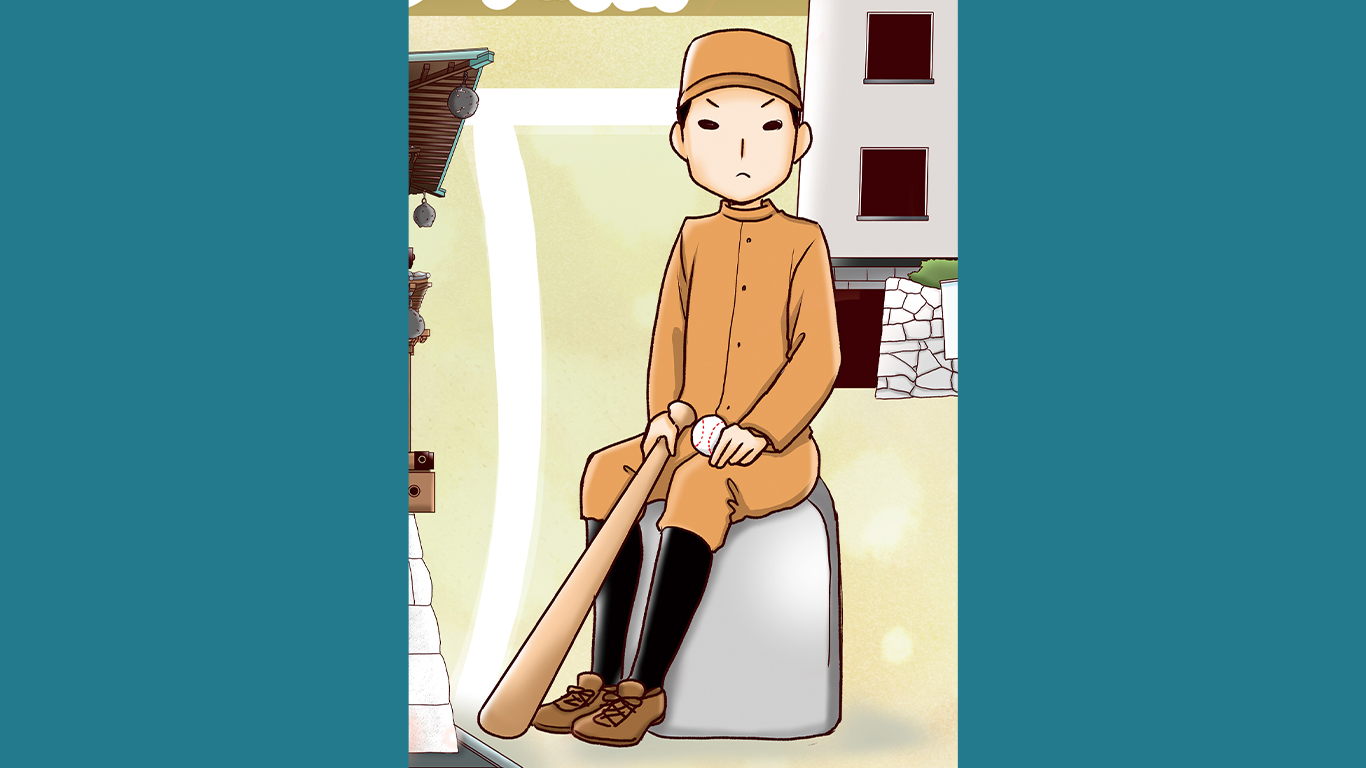
Masaoka Shiki (1867~1902)
Masaoka Shiki was born on September 17, 1867 in Matsuyama into a samurai family His real name was Tsunenori, but he was called Noboru as a child. After attending Matsuyama Middle School, Shiki left for Tokyo in 1883 He was first enrolled in the University. Preparatory School affiliated with the Imperial University (Tokyo University) and went on to enter the Imperial University. In 1889, Shiki coughed up blood. At this time a growing fascination with literature began and he decided to devote himself to it. He therefore withdrew from the university. At the age of 25 he was employed by the Nippon newspaper company, to write a column on literary topics. By introducing the word shasei’ (sketching from lite) Shiki brought about the advancement of reform in modern literature. Shiki went to China as a war correspondent in 1895, but the war had ended and his illness worsened on his way back to Japan. He returned to his hometown Matsuyama and stayed with Natsume Soseki at Gudabutsu-an for 52 days. Although Shiki was bedridden in his later years, many of his companions visited him daily at Shiki-an in Negishi, Tokyo. Despite his illness, his passion for literary activity increased, and his autobiographical essay Byosho Rokushaku (A Sixfoot Sickbed) was serialized in Nippon until two days before his death. Shiki died on September 19, 1902 at the age of 34. Shiki’s reform movement of literature influenced many writers such as Natsume Soseki, Kawahigashi Hekigoto, Takahahama Kyoshi, Ito Sachio and Nagatsuka Takashi. Shiki devoted himself to baseball as a teenager, and one pen name he used was ‘No-boru’ (feld-ball. the word used for baseball) which was derived from his childhood name Noboru. He wrote haiku and tanka on baseball and introduced the rules of baseball in the newspaper Nippon. He also coined the translations for words such as ‘pitcher’ (tosha), ‘batter’ (dasha), ‘runner’ (sosha), and ‘straight ball’ (chokkyu). In recognition of his contribution to the popularization of baseball, he was inducted into Japan’s Baseball Hall of Fame in January, 2002, marking the centennial of his death.
Masaoka Shiki was born on September 17, 1867 in Matsuyama into a samurai family His real name was Tsunenori, but he was called Noboru as a child. After attending Matsuyama Middle School, Shiki left for Tokyo in 1883 He was first enrolled in the University. Preparatory School affiliated with the Imperial University (Tokyo University) and went on to enter the Imperial University. In 1889, Shiki coughed up blood. At this time a growing fascination with literature began and he decided to devote himself to it. He therefore withdrew from the university. At the age of 25 he was employed by the Nippon newspaper company, to write a column on literary topics. By introducing the word shasei’ (sketching from lite) Shiki brought about the advancement of reform in modern literature. Shiki went to China as a war correspondent in 1895, but the war had ended and his illness worsened on his way back to Japan. He returned to his hometown Matsuyama and stayed with Natsume Soseki at Gudabutsu-an for 52 days. Although Shiki was bedridden in his later years, many of his companions visited him daily at Shiki-an in Negishi, Tokyo. Despite his illness, his passion for literary activity increased, and his autobiographical essay Byosho Rokushaku (A Sixfoot Sickbed) was serialized in Nippon until two days before his death. Shiki died on September 19, 1902 at the age of 34. Shiki’s reform movement of literature influenced many writers such as Natsume Soseki, Kawahigashi Hekigoto, Takahahama Kyoshi, Ito Sachio and Nagatsuka Takashi. Shiki devoted himself to baseball as a teenager, and one pen name he used was ‘No-boru’ (feld-ball. the word used for baseball) which was derived from his childhood name Noboru. He wrote haiku and tanka on baseball and introduced the rules of baseball in the newspaper Nippon. He also coined the translations for words such as ‘pitcher’ (tosha), ‘batter’ (dasha), ‘runner’ (sosha), and ‘straight ball’ (chokkyu). In recognition of his contribution to the popularization of baseball, he was inducted into Japan’s Baseball Hall of Fame in January, 2002, marking the centennial of his death.